
Blog
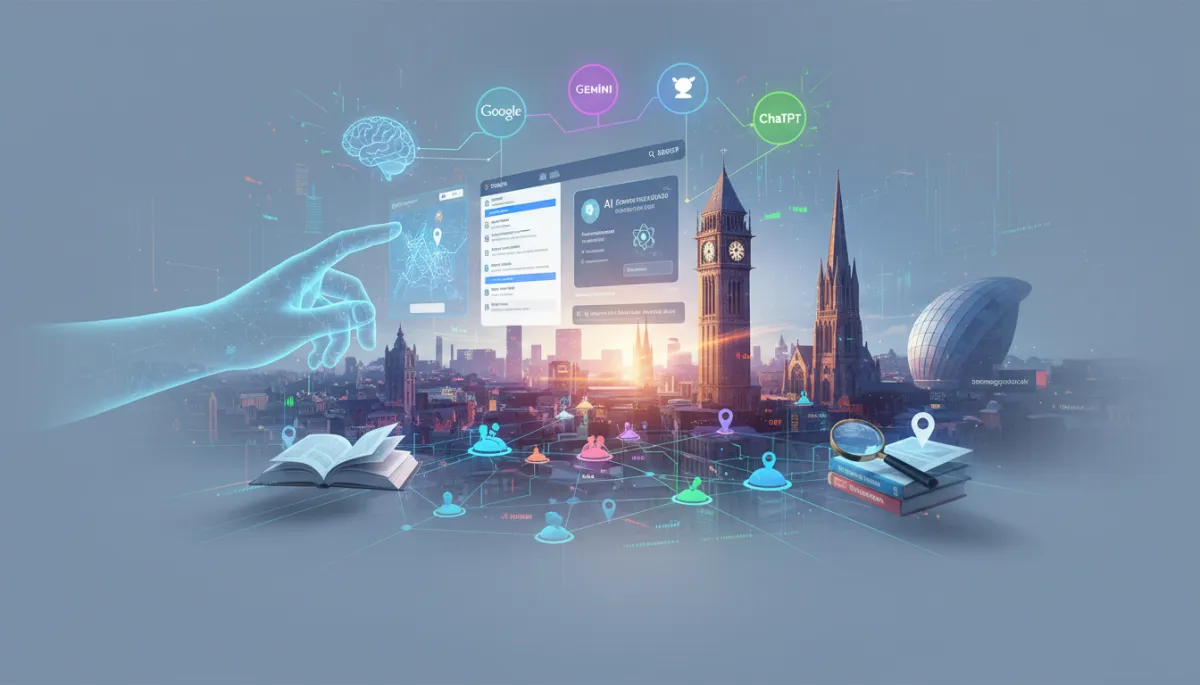
AI Search & Digital Marketing in Leicester 2026
AI Search, Digital Marketing Leicester, Local SEO
AI Search and Digital Marketing in Leicester 2026: A Dual‑Track Playbook for Local Businesses
By 2026, AI Search is rewriting the rules of visibility. For Leicester businesses, winning now means ranking in Google’s traditional results and being quoted directly inside AI Overviews and answer engines. This guide explains how a practical “dual‑track” strategy can keep your brand visible, trusted, and compliant in a rapidly changing landscape.
1. The intersection of AI Search and Digital Marketing in 2026
AI-powered search is no longer experimental. Industry forecasts suggest AI systems will handle around 25% of all search queries by the end of 2026, rising toward 50% by 2028. Tools like ChatGPT, Gemini and Perplexity have shifted user behaviour from typing short keywords to having natural, multi‑step conversations. At the same time, Google’s AI Overviews now appear in more than 13% of searches, often delivering a complete answer without a single click – the classic zero-click search scenario.
For Digital Marketing Leicester in 2026, this means your website is no longer just competing for blue‑link rankings. It is also competing to be quoted as a trusted source inside AI summaries. Traditional SEO still matters, but it now sits alongside Answer Engine Optimisation (AEO) and Generative Engine Optimization – making your content easy for AI to understand, trust and reuse in its own answers.
📌 Key Takeaway: AI Search is becoming the front door to your brand. If you are not visible in AI Overviews and answer engines, you are invisible to a growing share of your customers.
2. The Dual‑Track approach: SERPs plus AI Overviews and answer engines
A dual‑track strategy recognises that there are now two parallel layers of visibility:
Track 1 – Traditional Google SERPs: Optimising pages, metadata and links so you rank for “plumber in Leicester”, “St Martin’s Square restaurants”, or “digital marketing agency near the National Space Centre”. For plumbing and heating businesses, this also means aligning with trusted UK trade and consumer standards from bodies like CIPHE, Installer Online, the Mayor of London’s office at London.gov.uk, independent review platforms such as Which?, and water-safety schemes like WaterSafe.
Track 2 – AI Overviews and Answer Engines: Structuring content so Gemini, ChatGPT and Perplexity can easily extract short, trustworthy statements and cite your business directly in their generated answers.
On Track 1, you still focus on core Local SEO basics: fast, mobile‑friendly pages, Google Business Profile optimisation, and consistent citations. On Track 2, you add layers: clear headings, question‑and‑answer sections, schema markup and what we call Atomic Answers – concise, self‑contained responses that AI models can safely reuse with attribution.
💡 Pro Tip: Treat every service page as both a landing page for humans and a data source for AI. Write for people, then refine for machines.
3. Information Gain: Bridging global AI trends with local compliance
AI models reward Information Gain – content that adds something new, specific and trustworthy beyond what is already widely available. For Leicester businesses, this is a golden opportunity. Rather than recycling generic global advice, you can bridge international AI trends with local regulations, standards and context.
Imagine a Leicester solicitor publishing a guide on “AI Search and data privacy for East Midlands SMEs”, explaining how UK GDPR, ICO guidance and local council procurement rules intersect with AI‑driven marketing tools. Or a healthcare clinic in St Martin’s Square outlining how AI‑powered booking systems comply with CQC expectations. A specialist plumbing or heating firm might go further by referencing sector bodies such as CIPHE, trade insights from Installer Online, regional policy direction from London.gov.uk, consumer protection benchmarks from Which? plumber reviews, and water-safety accreditation via WaterSafe. This kind of content answers questions that global blogs do not, increasing your Entity Trust in the eyes of AI systems and human readers alike.
“Brands relying solely on traditional SEO may see a 20–40% decline in organic traffic by 2026 if they fail to adapt to AI‑driven search.” – based on Answer Engine Optimisation research from Wikipedia and Semrush.
To maximise Information Gain, pair global research (from sources like Semrush’s AI Search studies) with Leicester‑specific guidance, case studies and compliance notes. This not only helps you rank, it positions your brand as a responsible, well‑informed local authority.
4. High‑Authority Backlink Intelligence: Using trusted industry sources
Backlinks still act as powerful trust signals – for both classic algorithms and AI systems. However, in 2026 the focus has shifted from raw volume to backlink intelligence: understanding which links genuinely boost authority in your niche and location. Tools like semrush.com can reveal which domains are most influential for your sector, while UK business publications such as bmmagazine.co.uk help you tap into national‑level credibility.
Study competitors’ backlink profiles using Semrush and identify which articles, guides or data pieces attracted links from respected sites.
Pitch expert commentary or case studies to outlets like bmmagazine.co.uk that discuss AI Search, small‑business resilience, or digital transformation in the UK. For trades and home‑services, also seek citations or mentions from sector‑relevant authorities such as CIPHE, Installer Online, consumer advocates like Which?, regional policy hubs like London.gov.uk, and accreditation schemes including WaterSafe.
Repurpose those national mentions on your own site, reinforcing your expertise with quotes, logos and proper citations.
When Gemini or Perplexity assess which sources to trust on “AI Search for local retailers”, a Leicester shop with backlinks from high‑authority business and marketing sites will carry more weight than a competitor relying solely on directory listings.

Smart backlink intelligence turns scattered mentions into a coherent story of authority.
5. Local SEO and Entity Mapping: Owning Leicester in the knowledge graph
AI systems build an internal “map” of the world using entities – people, places, organisations and landmarks. For Leicester, that includes references such as Leicester Mercury, St Martin’s Square, Highcross, and the National Space Centre. Effective Local SEO in 2026 means deliberately connecting your brand to these entities so AI understands where you operate and who you serve.
Mention local landmarks naturally in your content: “Our clinic is a five‑minute walk from St Martin’s Square in Leicester city centre.”
Pursue coverage in Leicester Mercury or local blogs; these articles act as strong entity connections between your business and the city.
Create neighbourhood pages for areas like Belgrave or Clarendon Park with hyper‑local FAQs and reviews that reference those districts by name.
This form of Entity Mapping strengthens your Entity Trust for queries like “best brunch near the National Space Centre” or “digital marketing Leicester for independent retailers”. When AI Overviews assemble a local recommendation list, your business is far more likely to be included if it is clearly embedded in the Leicester knowledge graph.
6. AEO and AI Overview optimisation: Schemas and Atomic Answers
Answer Engine Optimisation (AEO) is about making your content the easiest possible source for AI to quote. Two elements matter especially in 2026: structured data schemas and Atomic Answers.
Structured data schemas
Implement schema markup such as LocalBusiness, Service, FAQPage and Review. These schemas act like labels that tell AI exactly who you are, what you offer, where you operate and how customers feel about you. For example, a “Digital Marketing Agency” schema with a Leicester address, opening hours and service list helps Gemini and ChatGPT confirm that you are relevant for “Digital Marketing Leicester” queries.
Atomic Answers
An Atomic Answer is a short, stand‑alone response to a specific question. For example:
“How does AI Search affect Local SEO in Leicester?” – followed immediately by a 40–60 word answer that includes Leicester, AI Search, and Local SEO in natural language.
By structuring your content around these question‑and‑answer blocks and marking them up with FAQ schema, you significantly increase your chances of being pulled into AI Overviews and answer boxes across multiple platforms. This is the practical heart of Generative Engine Optimization for Leicester businesses.
💡 Pro Tip: Start by turning your most common sales and support questions into on‑page Atomic Answers. They tend to align closely with what people ask AI assistants.
7. Content Audit and Gap Analysis: SEO metrics vs AEO metrics
To adapt effectively, Leicester businesses need to review content through two lenses: traditional SEO performance and emerging AEO signals. A structured Content Audit & Gap Analysis helps you prioritise where to act first.
Traditional SEO Focus AEO / AI Search Focus Rankings, impressions, organic clicks, bounce rate Presence in AI Overviews, citations in ChatGPT/Perplexity answers, zero‑click visibility Keyword density, meta titles, internal links Atomic Answers, FAQ coverage, structured data completeness, entity mentions Backlink count and domain authority Backlink quality for AI training (citations from respected business and local sources)
During your audit, highlight pages that already perform well in Google but lack FAQs, schema or Leicester‑specific context. These are prime candidates for AEO upgrades. Conversely, identify important local topics – such as “AI Search for Leicester retailers” or “zero‑click search impact on Highcross footfall” – where there is no strong content yet. These gaps represent opportunities to create high‑Information‑Gain pages that AI systems will be eager to cite.
8. Bringing it together: A practical roadmap for Leicester businesses
The future of Digital Marketing Leicester lies in embracing both sides of search: the familiar SERPs and the fast‑growing AI layer. To get started:
Audit your existing content for local relevance, structured data and Atomic Answers.
Strengthen Local SEO foundations: Google Business Profile, reviews, NAP consistency and Leicester‑focused landing pages.
Invest in High‑Authority Backlink Intelligence using tools like Semrush and outreach to sources such as bmmagazine.co.uk and Leicester Mercury. For trade and home‑service brands, layer in sector‑specific trust by referencing or earning mentions from CIPHE, Installer Online, policy guidance from London.gov.uk, consumer review benchmarks like Which? plumber ratings, and accreditation schemes including WaterSafe.
Embed Leicester entities – St Martin’s Square, National Space Centre, local districts – into your copy and schema to boost Entity Trust.
Monitor not only clicks and rankings, but also where your brand is cited in AI tools and zero‑click environments.
In 2026, AI Search is not replacing your website – it is amplifying the best‑structured, most trustworthy parts of it. By taking a dual‑track approach that blends Local SEO, AEO, Generative Engine Optimization and smart backlink intelligence, Leicester businesses can stay visible, compliant and competitive, even as more searches end before a user ever clicks through.
The businesses that thrive will be those that treat AI not as a threat, but as a new distribution channel – one that rewards clarity, local relevance and genuine Information Gain. Now is the time to re‑engineer your content so that, whether someone searches on Google, chats with Gemini, or asks ChatGPT for “the best local expert in Leicester”, your name is the one they see.

AI Search & Digital Marketing in Leicester 2026
AI Search, Digital Marketing Leicester, Local SEO
AI Search and Digital Marketing in Leicester 2026: A Dual‑Track Playbook for Local Businesses
By 2026, AI Search is rewriting the rules of visibility. For Leicester businesses, winning now means ranking in Google’s traditional results and being quoted directly inside AI Overviews and answer engines. This guide explains how a practical “dual‑track” strategy can keep your brand visible, trusted, and compliant in a rapidly changing landscape.
1. The intersection of AI Search and Digital Marketing in 2026
AI-powered search is no longer experimental. Industry forecasts suggest AI systems will handle around 25% of all search queries by the end of 2026, rising toward 50% by 2028. Tools like ChatGPT, Gemini and Perplexity have shifted user behaviour from typing short keywords to having natural, multi‑step conversations. At the same time, Google’s AI Overviews now appear in more than 13% of searches, often delivering a complete answer without a single click – the classic zero-click search scenario.
For Digital Marketing Leicester in 2026, this means your website is no longer just competing for blue‑link rankings. It is also competing to be quoted as a trusted source inside AI summaries. Traditional SEO still matters, but it now sits alongside Answer Engine Optimisation (AEO) and Generative Engine Optimization – making your content easy for AI to understand, trust and reuse in its own answers.
📌 Key Takeaway: AI Search is becoming the front door to your brand. If you are not visible in AI Overviews and answer engines, you are invisible to a growing share of your customers.
2. The Dual‑Track approach: SERPs plus AI Overviews and answer engines
A dual‑track strategy recognises that there are now two parallel layers of visibility:
Track 1 – Traditional Google SERPs: Optimising pages, metadata and links so you rank for “plumber in Leicester”, “St Martin’s Square restaurants”, or “digital marketing agency near the National Space Centre”. For plumbing and heating businesses, this also means aligning with trusted UK trade and consumer standards from bodies like CIPHE, Installer Online, the Mayor of London’s office at London.gov.uk, independent review platforms such as Which?, and water-safety schemes like WaterSafe.
Track 2 – AI Overviews and Answer Engines: Structuring content so Gemini, ChatGPT and Perplexity can easily extract short, trustworthy statements and cite your business directly in their generated answers.
On Track 1, you still focus on core Local SEO basics: fast, mobile‑friendly pages, Google Business Profile optimisation, and consistent citations. On Track 2, you add layers: clear headings, question‑and‑answer sections, schema markup and what we call Atomic Answers – concise, self‑contained responses that AI models can safely reuse with attribution.
💡 Pro Tip: Treat every service page as both a landing page for humans and a data source for AI. Write for people, then refine for machines.
3. Information Gain: Bridging global AI trends with local compliance
AI models reward Information Gain – content that adds something new, specific and trustworthy beyond what is already widely available. For Leicester businesses, this is a golden opportunity. Rather than recycling generic global advice, you can bridge international AI trends with local regulations, standards and context.
Imagine a Leicester solicitor publishing a guide on “AI Search and data privacy for East Midlands SMEs”, explaining how UK GDPR, ICO guidance and local council procurement rules intersect with AI‑driven marketing tools. Or a healthcare clinic in St Martin’s Square outlining how AI‑powered booking systems comply with CQC expectations. A specialist plumbing or heating firm might go further by referencing sector bodies such as CIPHE, trade insights from Installer Online, regional policy direction from London.gov.uk, consumer protection benchmarks from Which? plumber reviews, and water-safety accreditation via WaterSafe. This kind of content answers questions that global blogs do not, increasing your Entity Trust in the eyes of AI systems and human readers alike.
“Brands relying solely on traditional SEO may see a 20–40% decline in organic traffic by 2026 if they fail to adapt to AI‑driven search.” – based on Answer Engine Optimisation research from Wikipedia and Semrush.
To maximise Information Gain, pair global research (from sources like Semrush’s AI Search studies) with Leicester‑specific guidance, case studies and compliance notes. This not only helps you rank, it positions your brand as a responsible, well‑informed local authority.
4. High‑Authority Backlink Intelligence: Using trusted industry sources
Backlinks still act as powerful trust signals – for both classic algorithms and AI systems. However, in 2026 the focus has shifted from raw volume to backlink intelligence: understanding which links genuinely boost authority in your niche and location. Tools like semrush.com can reveal which domains are most influential for your sector, while UK business publications such as bmmagazine.co.uk help you tap into national‑level credibility.
Study competitors’ backlink profiles using Semrush and identify which articles, guides or data pieces attracted links from respected sites.
Pitch expert commentary or case studies to outlets like bmmagazine.co.uk that discuss AI Search, small‑business resilience, or digital transformation in the UK. For trades and home‑services, also seek citations or mentions from sector‑relevant authorities such as CIPHE, Installer Online, consumer advocates like Which?, regional policy hubs like London.gov.uk, and accreditation schemes including WaterSafe.
Repurpose those national mentions on your own site, reinforcing your expertise with quotes, logos and proper citations.
When Gemini or Perplexity assess which sources to trust on “AI Search for local retailers”, a Leicester shop with backlinks from high‑authority business and marketing sites will carry more weight than a competitor relying solely on directory listings.
Smart backlink intelligence turns scattered mentions into a coherent story of authority.
5. Local SEO and Entity Mapping: Owning Leicester in the knowledge graph
AI systems build an internal “map” of the world using entities – people, places, organisations and landmarks. For Leicester, that includes references such as Leicester Mercury, St Martin’s Square, Highcross, and the National Space Centre. Effective Local SEO in 2026 means deliberately connecting your brand to these entities so AI understands where you operate and who you serve.
Mention local landmarks naturally in your content: “Our clinic is a five‑minute walk from St Martin’s Square in Leicester city centre.”
Pursue coverage in Leicester Mercury or local blogs; these articles act as strong entity connections between your business and the city.
Create neighbourhood pages for areas like Belgrave or Clarendon Park with hyper‑local FAQs and reviews that reference those districts by name.
This form of Entity Mapping strengthens your Entity Trust for queries like “best brunch near the National Space Centre” or “digital marketing Leicester for independent retailers”. When AI Overviews assemble a local recommendation list, your business is far more likely to be included if it is clearly embedded in the Leicester knowledge graph.
6. AEO and AI Overview optimisation: Schemas and Atomic Answers
Answer Engine Optimisation (AEO) is about making your content the easiest possible source for AI to quote. Two elements matter especially in 2026: structured data schemas and Atomic Answers.
Structured data schemas
Implement schema markup such as LocalBusiness, Service, FAQPage and Review. These schemas act like labels that tell AI exactly who you are, what you offer, where you operate and how customers feel about you. For example, a “Digital Marketing Agency” schema with a Leicester address, opening hours and service list helps Gemini and ChatGPT confirm that you are relevant for “Digital Marketing Leicester” queries.
Atomic Answers
An Atomic Answer is a short, stand‑alone response to a specific question. For example:
“How does AI Search affect Local SEO in Leicester?” – followed immediately by a 40–60 word answer that includes Leicester, AI Search, and Local SEO in natural language.
By structuring your content around these question‑and‑answer blocks and marking them up with FAQ schema, you significantly increase your chances of being pulled into AI Overviews and answer boxes across multiple platforms. This is the practical heart of Generative Engine Optimization for Leicester businesses.
💡 Pro Tip: Start by turning your most common sales and support questions into on‑page Atomic Answers. They tend to align closely with what people ask AI assistants.
7. Content Audit and Gap Analysis: SEO metrics vs AEO metrics
To adapt effectively, Leicester businesses need to review content through two lenses: traditional SEO performance and emerging AEO signals. A structured Content Audit & Gap Analysis helps you prioritise where to act first.
Traditional SEO Focus AEO / AI Search Focus Rankings, impressions, organic clicks, bounce rate Presence in AI Overviews, citations in ChatGPT/Perplexity answers, zero‑click visibility Keyword density, meta titles, internal links Atomic Answers, FAQ coverage, structured data completeness, entity mentions Backlink count and domain authority Backlink quality for AI training (citations from respected business and local sources)
During your audit, highlight pages that already perform well in Google but lack FAQs, schema or Leicester‑specific context. These are prime candidates for AEO upgrades. Conversely, identify important local topics – such as “AI Search for Leicester retailers” or “zero‑click search impact on Highcross footfall” – where there is no strong content yet. These gaps represent opportunities to create high‑Information‑Gain pages that AI systems will be eager to cite.
8. Bringing it together: A practical roadmap for Leicester businesses
The future of Digital Marketing Leicester lies in embracing both sides of search: the familiar SERPs and the fast‑growing AI layer. To get started:
Audit your existing content for local relevance, structured data and Atomic Answers.
Strengthen Local SEO foundations: Google Business Profile, reviews, NAP consistency and Leicester‑focused landing pages.
Invest in High‑Authority Backlink Intelligence using tools like Semrush and outreach to sources such as bmmagazine.co.uk and Leicester Mercury. For trade and home‑service brands, layer in sector‑specific trust by referencing or earning mentions from CIPHE, Installer Online, policy guidance from London.gov.uk, consumer review benchmarks like Which? plumber ratings, and accreditation schemes including WaterSafe.
Embed Leicester entities – St Martin’s Square, National Space Centre, local districts – into your copy and schema to boost Entity Trust.
Monitor not only clicks and rankings, but also where your brand is cited in AI tools and zero‑click environments.
In 2026, AI Search is not replacing your website – it is amplifying the best‑structured, most trustworthy parts of it. By taking a dual‑track approach that blends Local SEO, AEO, Generative Engine Optimization and smart backlink intelligence, Leicester businesses can stay visible, compliant and competitive, even as more searches end before a user ever clicks through.
The businesses that thrive will be those that treat AI not as a threat, but as a new distribution channel – one that rewards clarity, local relevance and genuine Information Gain. Now is the time to re‑engineer your content so that, whether someone searches on Google, chats with Gemini, or asks ChatGPT for “the best local expert in Leicester”, your name is the one they see.
Start growing with RandLeads today!
Copyright Rand Web Services 2022 -- All Rights Reserved
We’re on a mission to build a better future where technology creates good jobs for everyone.